 |
| Demonstrating the colours, makeup styles, lighting and poses I would like to incorporate into my 2 shoots. |
Showing posts with label Research. Show all posts
Showing posts with label Research. Show all posts
Mood Board
Planning the Shoot: Lighting, Makeup, Hair and Poses
Lighting
 To create the soft focus images that I really loved on my model, I will place her infront of a large rectangular soft box so the background will be bright and gentle on the outlines of her hair and face. I will take photos front on in front of a white background to help lighten the image with reflection. To add to that, to remove any shadows where I don't want them I will have a helper to position the reflector where I need it. I will use 50mm and 80mm lenses to create the close ups and shoulder-up images we need.
 For the harsher, sharper images I will place the model in front of either a grey or black background (I will aim to use both to get a mixture of atmospheres and see which is the best outcome) and will use a reflector to remove any unwanted darkness and lighten to models face even more. I will use a beauty dish on the light instead of a soft box to create a bright and more direct source of light, but also to show her her natural beauty with the dish. I think for this set up with use both the lenses again to get various shots of her from every angle.
Makeup Look 1 (for setup 1)
Poses and Hair for Makeup and Setup 1
 To create the soft focus images that I really loved on my model, I will place her infront of a large rectangular soft box so the background will be bright and gentle on the outlines of her hair and face. I will take photos front on in front of a white background to help lighten the image with reflection. To add to that, to remove any shadows where I don't want them I will have a helper to position the reflector where I need it. I will use 50mm and 80mm lenses to create the close ups and shoulder-up images we need.
Makeup Look 1 (for setup 1)
 |
| For the first look, I want a perfected and flawless base with subtle highlight across the face. I will define the face slightly with contour to bring out my models natural beauty. The eyebrows will be filled in natural to add structure the the face and I want to add a simple sheen of bronze onto the eyelid with lots of mascara (no clumps though!) to emphasis my models eyes. The lips with either have a nude lipgloss or just vaseline to make the lips look healthy and moisturised. |
Poses and Hair for Makeup and Setup 1
 |
| My model has shorter hair than these images, but I will still style it in a similar way. I want to loosely curl her hair to create 'beachy' waves or a messy look to add to the minimlistic makeup. I want these black and white photos to be strong, beautiful images of her natural beauty so the harsher light will be focused on her face from different angles (front on and side on as the brief requires) but I would like to include the shoulders to switch up the poses. |
Makeup Look 2 (for setup 2)
 |
| As I am planning on creating both looks in the same session, I will add to the minimal natural look the model has on already. I will deepen the eye with darker browns and smoke out the lash lines. I will make the contour strong and add a red lip. I may also darker the brow if it is needed to tie the look together. |
Poses and Hair for Makeup and Setup 2
 |
| For the softer lighting set up, I had a stronger makeup look and want to reflect this in bolder poses. I will ask my model to use her hands and shoulders more and hopefully the soft light will make the images less intense and create a eye-catching contrast between the styling and lighting. Her hair will also be tied up and away from her face in a messy bun to keep the focus on the more extreme makeup and bolder poses. |
Mood Board Practise
In Kat's seminar, we
chose a word at random in the dictionary and were asked to create a
mood board of poses and lighting to reflect how we would style and
portray this idea. Mind was my chosen word and I began by
brainstorming synonyms and meanings that spring to mind and then
developed these into ideas and designs for hair, makeup and styling

For this concept, I
wanted to portray clean, crisp images of strong women representing
awareness of themselves and their mind. In regards to makeup designs,
I would have simple looks that would leave emphasis on the eyes and
highlights around the forehead representing the mind. The makeup
would be fresh and subtle to make sure it did not detract from the
concept. To extend the simplicity idea, the hair would be slicked
back or kept away from the face to leave the focus on the emotion and
features of the model. The photoshoot setup would have the lighting
directly on the models faces, to again highlight the head, and the
background would be plain with the space around the model staying
empty to represent spacial awareness (a human aspect of the mind) as
well as emotional awareness. The emphasis in this concept is to leave
the eye on the face of the model and the whole photo would centre
around them.

The first layout shown
here demonstrates my collection of relevant images I would include in
my mood board for the 'Mind' concept to communicate to my 'team' that
I would be working with. I have included a mixture of monochrome and
colour images to display the different and striking effects you would
get with each, but both could be used. Each model has a strong
emotional pose with the focus remaining on their faces and looks. The
second layout is another way I could display my visual ideas
alongside my written work to help my 'team' further with my concept.

Overall, I feel this
lesson was very useful to get to grips with the reasons behind using
mood boards to communicate your ideas as well as making your idea
clear in your own mind as well by whittling down the options you
would use to inspire your stylists, models and photographers.
Influential Imagery
From famous paintings to contemporary beauty advertisements, all imagery can be personally influential in someones life. Following our lessons on iconic photographers and the development of trends, we have been asked to find 5 images that are powerful in our eyes.
Editoral
 LOVE magazine is renowned for its innovative, authentic and creative images. This image specifically for me is a strong, bold image of a woman. Cara Delevingne is holding her head up, leaving a shadow creating a sharp jaw line and defined cheekbones. Although she is nude, her modesty is covered up by her arms leading up the the hands assisting the strong stature of her head and body. These techniques of directing the model in this way does not lead the viewer into thinking she is weak or naive (as some women can be portrayed in the fashion and beauty promotion world). The necklace is central therefore guiding the eye to the product and keeping the object of the photoshoot still in focus. Cara's striking face and the photographers composition makes the photo a genuine piece for me.
Beauty Advertising
 Scarlett Johansson featured in Dolce & Gabbana's 2012 campaign for their 'Perfect Luminous'. When I viewed this image close up, I feel the retouching is subtle and more realistic than most. Although the actual foundation look may not be be as achievable in real life, but I feel the softness and editing used makes this an inspiring photo. Also, Johansson may be under the sheets but not in a suggestive or provocative way. The colours are kept neutral and leaving the emphasis of the face (and the product it is advertising).
Famous Painting
 The Girl with the Pearl Earring is an iconic painting by Johannes Vermeer in 1655. The skill and artistry behind it leaves the viewer with an extraordinary and realistic portrait of a young woman. The lighting and shading almost makes it seem like a modern beauty shot. The simplicity of the makeup, hair and clothing (the colours are neutral and nude) bringing to attention to the sitter's eyes. Vermeer's portrait is influential to me as it reminds me how simple beauty can be.
 Contemporary Fine Art
David Downton is an illustrator and a celebrity portrait artist. Downton has painted (with inks) famous people like Cate Blanchett, Lily Cole and Twiggy. He uses varied tones and shades of black, grey and cream to outline and highlight the face. One or two shades of alternative colours may be added to develop the depth of the imagery. These pieces also demonstrate the simplicity of beautiful women. The realism makes his work iconic to me.
Beauty Editoral
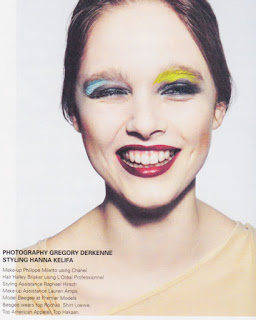 Taken from ID magazine, this editorial image inspires me through its use of emotion, colour and composition. Makeup artist Philippe Muerto has messily applied kohl eyeliner and dark shadow on the eyelids and taken this eye-look further with two bold colours smudged further. All primary colours are used in the image and the final shade red is used to create the classic, glossy, red lip. The combination of colours makes the image striking and alluring for viewers of the magazine. Having the model more relaxed with an open laughing mouth and half closed eyes opens the image up for a more friendly atmosphere. This sort of imagery is the inspiration of how I hope my skill level in makeup should develop to.
Editoral

Beauty Advertising

Famous Painting

 Contemporary Fine Art
David Downton is an illustrator and a celebrity portrait artist. Downton has painted (with inks) famous people like Cate Blanchett, Lily Cole and Twiggy. He uses varied tones and shades of black, grey and cream to outline and highlight the face. One or two shades of alternative colours may be added to develop the depth of the imagery. These pieces also demonstrate the simplicity of beautiful women. The realism makes his work iconic to me.
Beauty Editoral

Lighting, Directing and Choosing a Model
Our first seminar with Chris Overend explored how important the process of casting a model is, as well as how to treat and direct them once they are working with you.
Casting
Casting
- Untouched images needed from model - you must attain untouched photographs of the model, if you do not see them in person to start with, to see what you will really be working with. Polariods show a 'cast iron' image of the models face and can be the best way of seeing a fully natural and unphotoshopped photo.
- Even with professional models, always do castings - the emphasis is again on viewing the model's actual face. Professional models may have done huge campaigns and the images could have been unattractively photoshopped and you will not see the potential or vice versa - the model may fit your design more in a retouched image than in real life.
- Models must have a variety of poses - to be able to make your shoot interesting and easy (experienced models will switch poses between each shot in a photoshoot). This does mean a portfolio full of excellent poses demonstrates how hard it may be to get the model to be available. Less variety of images will mean the model may be easier to book but will need much more direction.
- Main London model agencies do release models for free - often the 'new faces' will only have a polaroid image and no portfolio so are looking for photographer and make up artists to aid their journey too.
- Choose the right model for your brief - for example, beauty imagery will need naturally beautiful features and your photographic techniques and stylists will emphasis these particular features subtly.
On Set and Directing
- It'll be fast paced to start with and the atmosphere will relax - setting up the shoot may be slightly stressed but the actual photoshoot has to be relaxed and positive. Otherwise, perspiration will start to show on models, makeup will get ruined and the models poses and expressions will be tense resulting in failed photos. Make sure everyone stays hydrated and cool.
- Only give models finished imagery - you do not want your name against untouched imagery as it does not demonstrate your hard work and polished final imagery and skill.
- Do not put too much pressure on yourself - this will reflect on the crew and models.
- Produce test shoots and plan - test shoots will aid you on the day of the photoshoot. Also, tear sheets will help the model understand what you want from them. Get into the studio and set up lighting beforehand and let the model relax (water is best for beauty!)
- Directing the model is crucial - as a photographer, you should be descriptive with your hands to aid the model. You can show the models the poses you desire through the camera and keep the model moving to prevent stiffness and a dull atmosphere prevailing into your final images.
- Talk to your model - strike up conversations and keep encourgement flowing. Be honest about their efforts, but not rude and as the photographer make sure your body language is open and positive.
- Finetune the photos - use tripod to get up close and personal to correct the details (must not be dependant on post-production).
- Catch the quiet moments - when the model is most relaxed can create this most beautiful shots.
Inside Vogue Japan - Mario Testino
This short film is a great example of the process photographers should undergo whilst producing research for a photoshoot. Testino uses books from Japan for inspiration for fashion styles and personalities of the models. Another process to follow would be questioning the public and being inspiried by street style. Testino gathers photos for other stylists and the models for guidance and Testino is very hands on with the makeup to produce the final image he desired for his concept. It is also key to keep the concept consistent.
Seven Photographs That Changed Fashion
In 2009, Rankin filmed a documentary for BBC Four about 7 influential beauty and fashion photographers who have evolved photography into what it is today. Rankin researched the icons, their outstanding photos and re-created some of the exemplary work in the contemporary, digital world.
Cecil Beaton
Flamboyant photographer Cecil Beaton created many Vogue covers throughout his career, specifically in the 'swinging sixties', with a 1932 Rolleiflex camera. This period camera had no mirror so the image would be upside for Beaton as he took the photo. Therefore, the set, model and style had to be extremely well thought out. Often with his photographs, all round lighting was used to create a light and subdued final image. In Beaton's 'White Panama Hat', I feel the the focus from the hat (the fashion piece for the cover of Vogue in 1934) is detracted and placed on the beauty of the model as the lighting and setup focuses the eye into the centre. In the documentary, Rankin initially attempted to re-create Beaton image with the period camera. As the process was lengthy and difficult, Rankin returned to his usual digital camera. The period photographic process had a slower pace and there is an emotional difference between the two models. The contemporary model Sophie Ellis-Bexter told Rankin she felt the dynamic behind the scenes of the period camera shoot changed and 'the film was a lot more quiet and tranquil'. The modern image shown above was used with a 21st century digital camera and takes the photos faster, making the image less emotive and stirring.
Erwin Blumenfeld
The influence of surrealism surrounded Blumenfeld's photography. Many of his portraits are distorted from variations of lighting concepts. The Vogue cover from 1950 optimises Blumenfeld's surreal imagery, and remains one of the most influential magazine covers of all time (the image was not edited in post production). Blumenfeld also has produced more Vogue covers than any other photographer of his time. The 1950 Vogue cover was originally taken in black and white but was bleached by Blumenfeld and was coloured by hand. Whilst researching Blumenfeld's image, Rankin reminds the audience that you 'do not question where the rest of the face is' and I completely agree. The image only contains her eye and lips but it still makes complete sense, showing how Blumenfeld's artistic approach is still effective for a beauty image to be used as the front page of a magazine.
Richard Avedon
Paris-based photographer Richard Avedon is another influential artist in the digital arts world. These two mirroring images show nature incorporated into the fashion industry. The original image created in 1955 by Avedon had elephants tied down with chains, whereas, the elephants in 2009 seem to be free (with zoo keepers outside calming and taming the mammals). Movement is a strong feature in Avedon's 'Dovima with Elephants' image and this is unusual within his work, with his usual focus being of beauty and celebrity portraits, making this photograph an extremely original and brave piece.
David Bailey
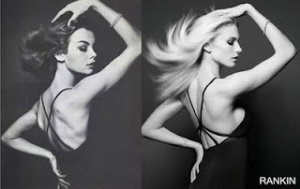
David Bailey always had bought great energy, life and charm to his photos. Rankin explains how his imagery has a 'sense of spontaneity'. In the Bailey's photograph for Vogue, he used Jean Shrimpton (his lover at the time) as his model and only used a large piece of cardboard to create the wind demonstrated in her 'hair flick'. Her stature and flowing hair is iconic but does not detract from her beautiful profile. Rankin re-created this image with his model girlfriend and used he used the same techniques to create the hair drop. Both images are similar and leave the emphasis on the models figure, pose and beauty.
Helmut Newton
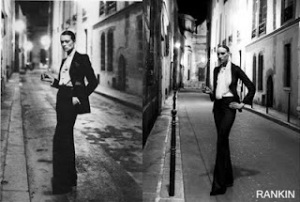
Known for his provocative fashion imagery, Helmut Newton reinvented what fashion photograph suggests and represents. Often including women in their underwear, or sometimes in the nude, his style empowered women rather than objectifying them. He also perfected beauty portraits in his photography career. 'Rue Aubriot' presented in Vogue shows off this woman's height and an edge of masculinity, potentially suggesting the equality between men and women. The background streets also creates an intense, romantic, film-like setting to amplify the model's stature and importance.
Guy Bourdin
Guy Bourdin developed the stylising of sex through the seventies in a sophisticated way. His commercial images were adventurous, colourful and sexual but always had a feel of art within them. With Bourdin's lighting, the soft-boxes or spotlights would face directly on the model to light up the models complexion, outfit and expression. Rankin's contemporary interpretation used the same technique with lighting, however, made the hair and makeup more dramatic whilst covering the legs with bright tights. The images are very similar in regards to poses yet I personally feel Rankin escalated the colour palette and saturation too much. Bourdin subtly emphasises the model's sexuality purely through the pose and revealing leotard.
Herb Ritts
 Herb Ritt's 'Fred with Tyres' transformed how men were perceived in the fashion industry. Following the photographic trend through the 70's of empowering the sexuality of women, this was then followed by the men of the 80's. The rough sexuality of the man against a 'manly' background became a catwalk hit and quickly was named 'one of the photos that changed fashion'. When Rankin re-produced his version lightheartedly named 'Dave with Tyres', the contrast was amplified in post production to reflect Ritt's photographic style.
Overall, these photographers demonstrate the massive transition over the years of fashion and beauty photography. Through my first semester studying digital image production, I will use these artists to reflect on and inspire me to use a wide variety of techniques and themes to produce the 'perfect' colour and black & white beauty images.
References
Cecil Beaton
 |
| Rankin, 2009. Vogue, 1934. |
 |
| Vogue, 1950. Rankin, 2009. |
The influence of surrealism surrounded Blumenfeld's photography. Many of his portraits are distorted from variations of lighting concepts. The Vogue cover from 1950 optimises Blumenfeld's surreal imagery, and remains one of the most influential magazine covers of all time (the image was not edited in post production). Blumenfeld also has produced more Vogue covers than any other photographer of his time. The 1950 Vogue cover was originally taken in black and white but was bleached by Blumenfeld and was coloured by hand. Whilst researching Blumenfeld's image, Rankin reminds the audience that you 'do not question where the rest of the face is' and I completely agree. The image only contains her eye and lips but it still makes complete sense, showing how Blumenfeld's artistic approach is still effective for a beauty image to be used as the front page of a magazine.
Richard Avedon
 |
| Vogue, 1955. Rankin, 2009. |
David Bailey
 |
| Vogue, 1962. Rankin, 2009. |
David Bailey always had bought great energy, life and charm to his photos. Rankin explains how his imagery has a 'sense of spontaneity'. In the Bailey's photograph for Vogue, he used Jean Shrimpton (his lover at the time) as his model and only used a large piece of cardboard to create the wind demonstrated in her 'hair flick'. Her stature and flowing hair is iconic but does not detract from her beautiful profile. Rankin re-created this image with his model girlfriend and used he used the same techniques to create the hair drop. Both images are similar and leave the emphasis on the models figure, pose and beauty.
Helmut Newton
 |
| Vogue, 1975. Rankin, 2009. |
Guy Bourdin
 |
| Top: Vogue, 1970. Bottom: Rankin, 2009. |
Herb Ritts
Overall, these photographers demonstrate the massive transition over the years of fashion and beauty photography. Through my first semester studying digital image production, I will use these artists to reflect on and inspire me to use a wide variety of techniques and themes to produce the 'perfect' colour and black & white beauty images.
References
Seven Photographs That Changed
Fashion (2009). Rankin for BBC Four
Who Do You Think You Are, David Bailey?
For our first project in digital imagery production, we are researching, practising and creating beauty shots. I will be looking in various lighting concepts, photographic techniques and photographers as inspirations to produce my own 2 final beauty photographs.


References
Beauty and Fashion Photographers
David Bailey

David Bailey began in the industry through assisting photographer John French in 1959 and started a contract with Vogue in the 1960's. His expertise is working with black and white imagery within the beauty and fashion industry. I notice in his images that lighting in a key element in creating the striking and beautiful stills. The light creates shadows and highlights in the exact places to emphasise the models beauty and bone structure. Bailey also uses hair to frame the face, but not detract from it.
Erwin Blumenfield

Erwin Blumenfield starting taking his first photos at the age of 10 and as he grew into his own has become one of the most influential photographers of the 21st century. Blumenfield spent time experimenting in darkrooms and his photos reflect his exploration with lighting. His famous Vogue 1950 cover was not at all edited and has become one of the most iconic covers of all time.
George Hurrell
 Originally trained as a classic painter, George Hurrell worked as a portrait photographer for some of the most famous Hollywood motion picture studios in the 1930's. Hurrell was used to promote films and celebrities through glamour and beauty. His system of using lights from infront, at a side angle and behind results in these stunning images which have layers of light and shadow. The spotlight highlights the models attributes in a very glamorous way whilst portraying sincerity with the models facial expression. These images are timeless and have become iconic for their hollywood glamour and classic beauty.

Patrick Dermarchelier
 Dermarchelier is one of the most famous commercial and editorial photographers of the 21st Century. He has shot many superstars and supermodels for Vanity Fair and Vogue as well as being a part of various multi-million advertising campaigns. After researching these photographers, Patrick Dermarchelier has really stuck out for me and I really admire his style of work. He does not only use the model as a 'coathanger' for the product or item of clothing, but makes them the focus of the image. His black and white imagery is really striking through his use of lighting highlighting parts of the face, and the make up used in the photo above with Chloe Grace Mortez ties the photo together perfectly in my opinion. The deep lips almost becomes part of the shadows of the face, however, it is the most eye-catching part of the image with the subtle sheen contrasting the dark shades. Colour is also a main element in his imagery by using bold shades to draw attention to certain features - the lips, the fabrics or the eyes for example.

Mario Testino
 Mario Testino grew up in Peru until 1977 where he moved to London, at the age of 22, to follow his dreams of being a photographer. He is known for beautiful and lively imagery of the most famous women in the world. He uses their personalities in the photos to bring character into the image and give the photo depth - instead of just being about the beauty. Makeup is a huge aspect of his imagery as it is used more creatively than your standard beauty image. Lipsticks are smudged or used as eyeshadows, it is used to transform the person into an icon (as shown above with Miley Cyrus being transformed into a flirtatious Marilyn Monroe) and is used to add an element of sexuality to the atmosphere. More often than not, in his colour imagery he uses bold red or warm toned colours to bring out features like the lips or eyes to allure the viewer.

References
- National Portrait Gallery, 2015, David Bailey (1938-) Photographer and Filmmaker [viewed on 1st October] Available at: http://www.npg.org.uk/collections/search/person/mp05044/david-bailey
- AnOther, 2013, 20 Things You Should Know About David Bailey [viewed on 1st October] Available at: http://www.anothermag.com/art-photography/2750/20-things-you-should-know-about-erwin-blumenfeld
- The Walt Disney Family Museum, 2015, Lights! Camera! Glamour! The Photography of George Hurrell [viewed on 3rd October] Available at: http://www.waltdisney.org/hurrell
- Luke Leitch, 2012, Patrick Demarchelier: 'My Job Is To Make Clothes Look Beautiful - But With Couture, It's Easy' [viewed on 3rd October] Available at: http://fashion.telegraph.co.uk/news-features/TMG8990230/Patrick-Demarchelier-My-job-is-to-make-clothes-look-beautiful-but-with-couture-its-easy.html
- Dan Collyns, 2014, Mario Testino Returns to Home to Focus on the Beauty of Peru [viewed on 3rd October] Available at: http://www.theguardian.com/artanddesign/2014/apr/29/mario-testino-lima-return-england-photograhy